
Voltage Explained
5V, 12V, 24V, and 48V
Permanent Lighting Voltage
Voltage decides how far a permanent outdoor lighting system can carry power before it needs another power injection box, and how much heat builds up in the wire along the way.
The Three Things to Know About Voltage
Voltage is listed on almost every permanent lighting spec sheet, but the number alone tells you little. These three points explain what it actually changes.
Higher Voltage = Less Heat
Heat in a wire is determined by current, not voltage. P = V x I. Doubling the voltage halves the current. Halving the current cuts wire heat by 75 percent.
Watch at 5:11Brightness Comes From Current
Voltage does not necessarily mean brightness -- current does. Higher-voltage systems carry current better, so a 48V run keeps steady power all the way down the roofline without dimming at the far end.
Watch at 23:43Engineering Beats Voltage Alone
A poorly designed 48-volt system can still lose to a well-built 12-volt one. The chip, the driver, the protection circuitry, and the app decide whether a high-voltage spec becomes a reliable install.
Watch at 19:22Watch the Full Voltage Breakdown
Bowdrie from TruLight walks through the physics and real install numbers from TruLight dealers.
Jump to a Section
What Is Voltage and Why Does It Matter?
The four voltage tiers you see in permanent lighting were each designed for a different use case. Here is what each one means for a real roofline install.
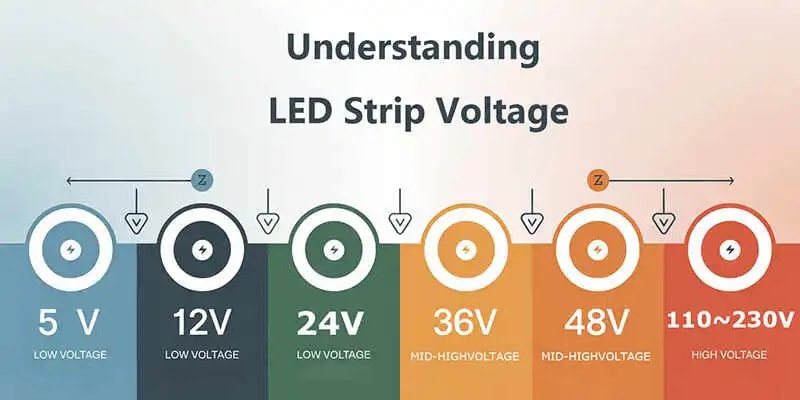
5V
Indoor / DIY
Designed for indoor electronics and short LED strip runs. Not built for residential rooflines. Needs power injection every 5-30 lights.
12V
Legacy Permanent Lighting
The original permanent-lighting voltage. Used by Trimlight, Bosso, and Gemstone. Power injection every 50-70 lights. More boxes on your fascia.
24V
Mid-Range
Current mid-range tier. Used by Celebright and Haven EVO. Power injection every 50-100 lights. Better than 12V but still well below 48V.
48V
What We InstallTruLight -- What We Install
Power injection every 400+ lights. 90% of TruLight homes need one injection box or less. Lowest wire heat, best long-run brightness consistency.
How Many Power Injection Boxes Does Each Voltage Need?
Every power injection adds a box on your fascia and wires through your soffit -- plus one more connection that can fail. Lower-voltage systems need many more of them.
5-Volt Systems
Every 5-30 lightsBuilt for indoor strip lighting. Not designed for residential rooflines.
12-Volt Systems
Every 50-70 lightsTrimlight, Bosso, and Gemstone all use 12V. More boxes on the front of your home.
24-Volt Systems
Every 50-100 lightsMid-range. Celebright and Haven EVO. Better than 12V but still far below 48V.
48-Volt Systems (TruLight)
Every 400+ lights90% of TruLight homes need one injection box or less. Most homes have under 300 linear feet of roofline.
Why Higher Voltage Means Less Heat in the Wire
P = V x I. Power equals voltage times current. To deliver the same amount of power, a higher-voltage system needs less current.
P = V x I
Power Law
To deliver the same power, doubling voltage halves current.
Q = I2 x R
Heat Law
Heat is current squared times resistance. Halving current cuts heat by 75%.
-75%
Wire Heat Reduction
Going from 12V to 48V at the same brightness cuts wire heat by three-quarters.
Vicor, a major power-electronics manufacturer, publishes the math directly in their technical literature: "By increasing the bus voltage to 48V you can cut your distribution losses up to 75%, which dramatically reduces heat generation."
The power grid works the same way. Utilities send electricity at hundreds of thousands of volts and step it down at a substation near your house, because higher voltage loses less to heat over distance. A permanent lighting run follows the same principle on a much smaller scale.
Voltage Tier Comparison
| Spec | 5V | 12V | 24V | 48V (TruLight) |
|---|---|---|---|---|
| Power Injection Interval | Every 5-10 lights (indoor strip) | Every 50-70 lights | Every 50-100 lights | Every 400+ lights |
| Typical Use | Indoor strip / DIY | Budget / older perm | Mid-range perm | Premium perm + commercial |
| Wire Heat (same brightness) | Highest | High | Moderate | Lowest |
| Long-Run Brightness Consistency | Poor | Needs injections | Better | Best |
| Truck Analogy | RC car | Standard pickup | Heavy-duty pickup | Semi-truck |
Not All 48-Volt Systems Are Equal
Voltage alone does not make a system good. A poorly designed 48-volt system can still be worse than a great 12-volt system.
What Higher Voltage Requires
- Better voltage conversion circuitry
- Protection circuitry designed for 48V
- A chip engineered for higher-voltage RGBW
- An app built for the specific hardware
How TruLight Does It
- UCS7604 chip -- designed for higher-voltage RGBW
- 6 LEDs per node: 3 RGB + 3 dedicated warm white
- 48V bus with full protection circuitry
- App built specifically for this hardware
- Limited lifetime warranty on dealer installs
Why Lumens Marketing Can Mislead You
Lumens are a real unit of measurement, but how a company reports them is wide open.
A cheap lumen meter and a premium lumen meter give very different readings. Distance to the source, angle, ambient light, and even the meter brand all affect the number. In the video, Bowdrie holds a single light at different distances from a lumen meter, and the reading swings from 100 to about 800.
Brightness comes from current, and a higher-voltage system holds current steadier along a long run. A lumen reading taken at one light says little about how even the whole roofline will look.
If a permanent lighting company leads its pitch with a high lumen number, ask: at what distance, with what meter, and at what point on the run it was measured.
A Note on Misleading Marketing Claims
A 24-volt brand published an article titled "Permanent Outdoor Lights: The Hidden Cost Of 48-Volt Lighting Systems" arguing that 48V systems "put a lot of power running through the wires, which creates a lot of heat" and that this leads to a shorter lifespan.
That framing inverts P = V x I. Higher voltage means lower current at the same power, and lower current means less heat. We address that article directly in the video.
Voltage is easy to misstate in marketing copy. Read any claim about it with P = V x I in mind. Ask the installer why their voltage suits your home and what it changes about the install. A good answer is specific and backed by public data.
See this section of the video at 2:21Straight From the Video
"Higher voltage means less current. Less current means less heat. More efficient. Longer-lasting lights."
The core physics of voltage in a permanent lighting system
5:11"Our voltage is higher, less heat, longer-lasting light."
On why higher voltage and longer LED life go together, and why TruLight can offer a limited lifetime warranty
6:25"A poorly designed 48-volt system can still be worse than a great 12-volt system."
Voltage alone does not guarantee quality
19:22"Lumens are a unit of measurement that cheap lights use to try and compete with higher-powered systems."
On why lumens marketing can mislead
27:52See Where the Boxes Would Go on Your House
NightGlow 365 will walk your home, show you where the controller and any power injection would go on your roofline, and quote the install.